

For families raising autistic children, evenings can sometimes become the most difficult part of the day. A child may seem utterly exhausted but still refuse to go to bed. Another may fall asleep easily but wake several times during the night. Some children wake before the rest of the family and struggle to settle again.
These patterns can be exhausting for parents. They can also have an effect on what happens the next day. Due to poor sleep children often become irritated and have difficulty concentrating, trouble with transitions, or stronger reactions to situations that are normally manageable.
This does not mean that every challenging behavior is caused by lack of sleep. Autism is complex, and behavior can have many different causes. Still, sleep is an important part of the picture.
Understanding the connection between sleep and autism can help parents make bedtime less stressful.
Why Do Autistic Children Have Trouble Sleeping?
There is no single explanation for sleep problems in children with autism.
For some children, sensory sensitivities may be part of the issue. A ticking clock, traffic outside the window, a bright hallway light, or the feeling of a particular blanket can be enough to make settling down difficult. A child with heightened sensory sensitivity may find them extremely distracting.
Autistic children usually feel comfortable when they know what will happen next. If bedtime is inconsistent, it may become difficult for them to sleep well.
What Happens When a Child Does Not Sleep Well?
Parents often notice the effects of autism sleep problems the following morning. A child might have difficulty dressing up. At school, the child might experience difficulty in concentration. It can affect their mood and ability to regulate emotions.
For an autistic child who already has difficulty dealing with certain sounds, social situations, changes, or transitions, being fatigued can make those demands harder to handle.
Building an Autism Bedtime Routine
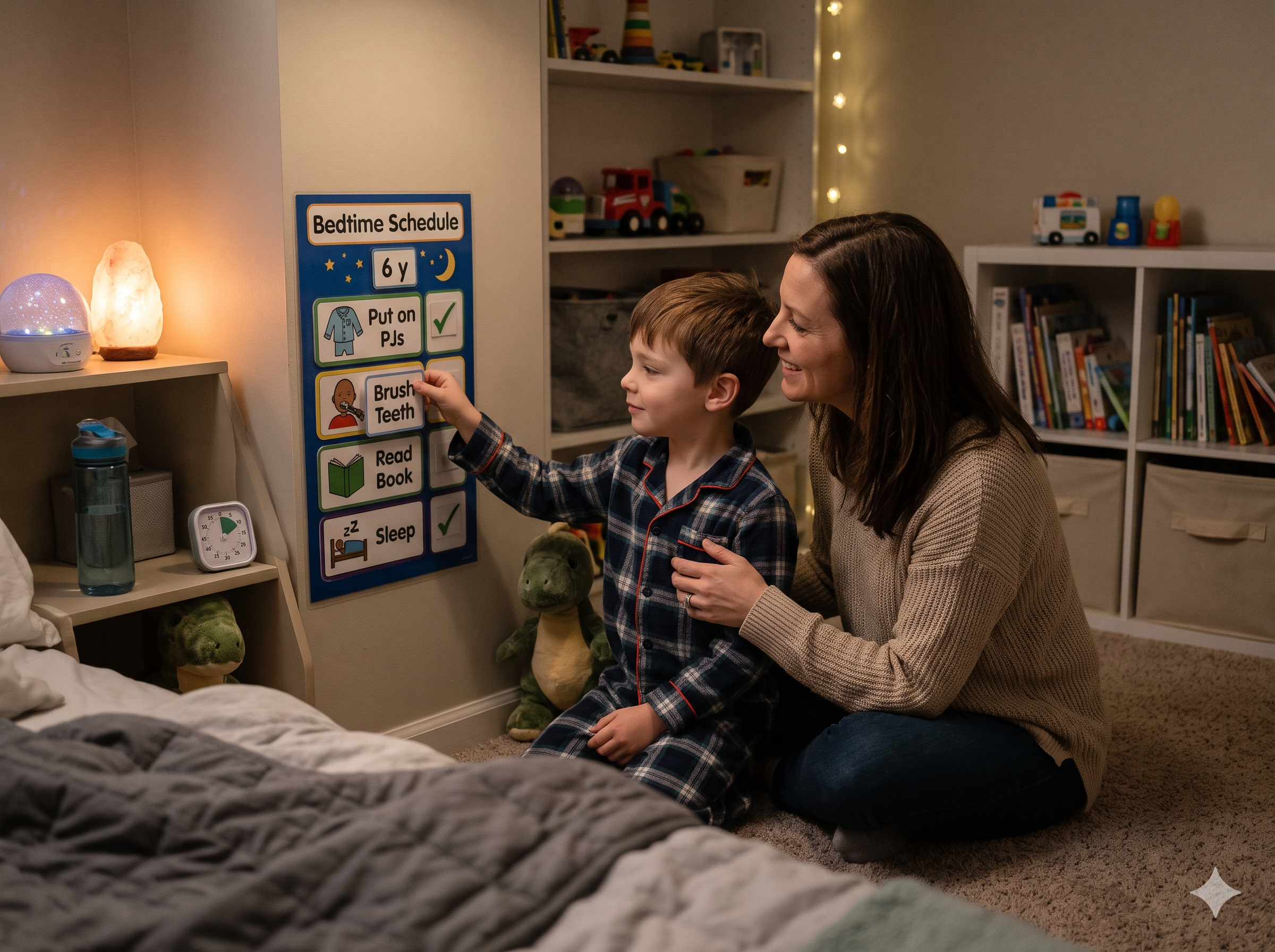
A predictable autism bedtime routine can make the evening easier because the child does not have to keep guessing what happens next. Think of the routine as a sequence rather than a strict set of rules.
They very well understand the steps, such as
Pajamas → bathroom → brush teeth → favorite book → bed
The activities can be different for every family. What matters is that the order remains reasonably familiar.
If the child knows that brushing teeth is followed by a story and the story is followed by bed, the transition becomes more predictable over time.
A visual schedule can also be helpful for children who respond better to pictures than spoken instructions. A few simple pictures on the wall can show the sequence without a parent having to repeat the same instructions several times.
That can make a surprisingly big difference on a difficult evening.
Bedtime Autism Strategies
Here are the bedtime strategies for autism that parents can practice:
A slower evening
If your child has been playing, watching television, or using a tablet, asking them to go to bed immediately may create resistance. You should create a short period when things become quieter.
Reading, coloring, or listening to calm music may work better than another highly stimulating activity.
It will slow them down and reduce sleep problems in autistic children.
Pay attention to the bedroom
To ensure they have a sound sleep, ensure their bedroom is quite comfortable. Check if the child can hear a television in another room? Is the room unusually warm? Does the pajama fabric bother them? Is the mattress or bedding uncomfortable?
Parents sometimes discover that a minimal environmental change solves a problem they had been trying to manage with repeated bedtime instructions.
Give warnings before transitions
If your child becomes upset whenever an activity ends, the problem may begin before bedtime itself. Instead of suddenly announcing that the tablet or favorite game is finished, provide a warning.
You have ten more minutes.
A visual timer can also be useful.
Offer limited choices
Bedtime does not have to be completely controlled by the parent. Small choices can give a child some control without changing the overall routine.
“Blue pajamas or red pajamas?” “Which book?” “Do you want the bedroom door open or closed?”
The child gets to make a few decisions, and that can help reduce resistance among some children.
Avoid changing everything at once
Parents who have been struggling with sleep for months may understandably want to try everything. But introducing five new rules on the same night can make it difficult to know what actually helped.
Try one or two changes first.
Give the child time to become familiar with the change.
What About a Child Who Needs a Parent Beside Them?
Some children will not fall asleep unless a parent stays in the room. Whether the situation needs to change depends on the family. If everyone is sleeping well and the arrangement works, there may be no urgent reason to change it. But if a parent has to stay beside the child for an hour every night or return to the bedroom repeatedly after nighttime waking, it can become exhausting.
A gradual approach may be easier than suddenly leaving the room.
A parent might start by sitting beside the bed, then move the chair a little farther away every few nights. The child continues to see the parent, but the amount of assistance gradually changes.
The pace should depend on the child. If the process creates distress, the parent must stop and may take professional guidance.
How Willow Reach Can Help Families
Willow Reach offers autism sleep support to the children, where therapists work with families to understand their individual needs.
Its services include in-home ABA therapy, parent training, and individualized assessments. Parent involvement is an important part of this type of support because strategies often need to continue outside therapy sessions and become part of everyday family life.
For families dealing with bedtime challenges, that individualized approach can be relevant. Sleep difficulties rarely look exactly the same from one child to another. A strategy that works well for one child may not work for another, particularly when sensory needs, communication abilities, and daily routines are different.
Willow Reach also provides educational resources for families who want to learn more about autism, ABA therapy, and related topics. Parents considering services can use these resources to better understand what support may involve and what questions they may want to ask before beginning therapy.
The focus should always remain on the individual child and the family’s circumstances rather than following a generic program simply because it worked for someone else.
Final Thoughts
An autistic child may have a hard morning because of sensory overload, a change at school, communication difficulties, frustration, anxiety, or many other reasons.
But when sleep is consistently poor, it can make everyday challenges harder to handle.
A consistent routine, a calmer transition, a comfortable bedroom, and clear expectations can give a child a more predictable end to the day. Sometimes the change is small, a different bedtime sequence, a visual reminder, or a few minutes of warning before an activity ends.
Parents do not need to fix everything in one night. Start by observing what happens. Make one change at a time and give the child an opportunity to adjust.
For families navigating sleep and autism, a better bedtime routine is not about enforcing a rigid schedule. It is about helping the child understand what comes next and creating an environment where sleep feels safe, familiar, and manageable.
Frequently Asked Questions
1. Why do autistic children have sleep problems?
Answer: There can be several reasons. Sensory sensitivities, difficulty with changes in routine, anxiety, differences in sleep patterns, and other health or environmental factors may contribute. The reason is different for every child.
2. What is a helpful bedtime routine for an autistic child?
Answer: A good routine is predictable and easy to repeat. It could include pajamas, brushing teeth, using the bathroom, reading a book and going to bed.
3. Can poor sleep affect an autistic child’s daytime behavior?
Answer: Yes, poor sleep is responsible and can affect an autistic child’s behavior. A child who has not slept well may have more difficulty paying attention to things happening around. However, sleep is only one possible factor behind changes in behavior.
4. How can parents make bedtime easier for autistic children?
Answer: It is critical for parents to stay consistent. Keep bedtime and wake-up times reasonably regular, reduce stimulating activities before bed, check the child’s sensory environment, and use clear warnings before transitions. Changes are often easier when introduced one step at a time.
5. When should parents seek autism sleep support?
Answer: Parents should seek autism sleep support when difficulties continue despite them making all the changes they can to the sleep routine and sleep environment. Things such as mouth breathing, loud snoring, or nighttime movements should also be evaluated.