


Suppose a family is getting ready to leave for school, and a child finds out that their favorite shirt is in the wash. The child cries, refuses to move, or starts throwing clothes across the room. A parent tries to point out that another shirt will work just as well, but the explanation doesn’t work.
Situations like these can leave parents wondering what went wrong. The change seems small to an adult, yet the child is having a genuinely difficult time coping with it. For autistic children, unexpected changes, sensory discomfort, communication difficulties, and everyday demands can make certain situations harder to manage.
This scenario is where ABA therapy and emotional regulation support may help. Applied Behavior Analysis (ABA) can be used to teach practical skills such as asking for help, requesting a break, preparing for transitions, and communicating discomfort.
What Does Emotional Regulation Mean for an Autistic Child?
Emotional regulation is the ability to recognize, respond to, and manage emotions.An autistic child might find it difficult to explain why a room feels unbearable, why a change in plans is upsetting or why a task seems too demanding. There is no single explanation for emotional regulation difficulties in autism.
Sensory sensitivities, uncertainty, communication barriers, fatigue, and anxiety can all contribute. Pain or other health concerns may also affect behavior, particularly when a child cannot easily describe what they are experiencing.
A child covering their ears and crying in a noisy shopping center may need relief from the noise instead of a lesson in following instructions. A child who becomes distressed during a difficult task may need help understanding it or communicating that they need a break.
The aim of ABA for emotional regulation is to improve the child’s comfort, communication, and ability to cope.
How ABA Therapy Can Help With Emotional Regulation
ABA examines the relationship between behavior, the environment, and what happens before and after an event. An individualized program can help identify patterns and teach skills that give a child more ways to respond.
This means that therapy should be planned around the individual child, with progress assessed rather than assumed.
Understanding what triggers distress
Parents often notice that difficult moments happen in particular situations. Things that trigger distress can include ending screentime or changes in a routine.
A behavior analyst may use Antecedent-Behavior-Consequence (ABC) recording to understand these patterns. The antecedent is what happens before the behavior, the behavior is what can be observed, and the consequence is what happens after.
Consider a child who throws their toys when asked to tidy up. Looking more closely, the family and therapist might learn that the instruction comes without warning while the child is deeply involved in play. The child may be struggling with the sudden transition, although the family and therapist need to assess the situation further to understand it fully.
This could involve giving advance notice, using a visual cue, or breaking the tidy-up routine into smaller steps. They would then observe whether the changes help.
ABC recording helps adults identify patterns worth investigating, alongside the child’s communication, preferences, and other relevant information.
Teaching children to communicate before frustration builds
A child who cannot explain their needs may resort to whatever response has worked for them before. Crying, pushing materials away, or leaving an activity can sometimes signal that something is wrong, although the meaning varies from one child to another.
Functional Communication Training (FCT) is an ABA approach that teaches a more effective way to communicate a need or request.
Adults also have a role in this process. If a child appropriately requests a break, the request needs to be taken seriously and handled according to an agreed plan. Teaching communication is unlikely to be helpful if the child learns that communicating their discomfort makes no difference.
Over time, the child may have a more reliable way to ask for assistance instead of reaching a point where distress becomes intense.
Practicing coping skills when the child is calm
It is difficult to learn something new in the middle of a major emotional outburst. When a child is already overwhelmed, repeated instructions and lengthy explanations may add to the pressure.
For this reason, coping skills for autism are usually best introduced during calmer moments.
Depending on the child, useful options might include asking for a break, moving to a quieter area, using a familiar sensory tool, taking a pause from a demanding activity, or practicing a breathing exercise if that feels comfortable.
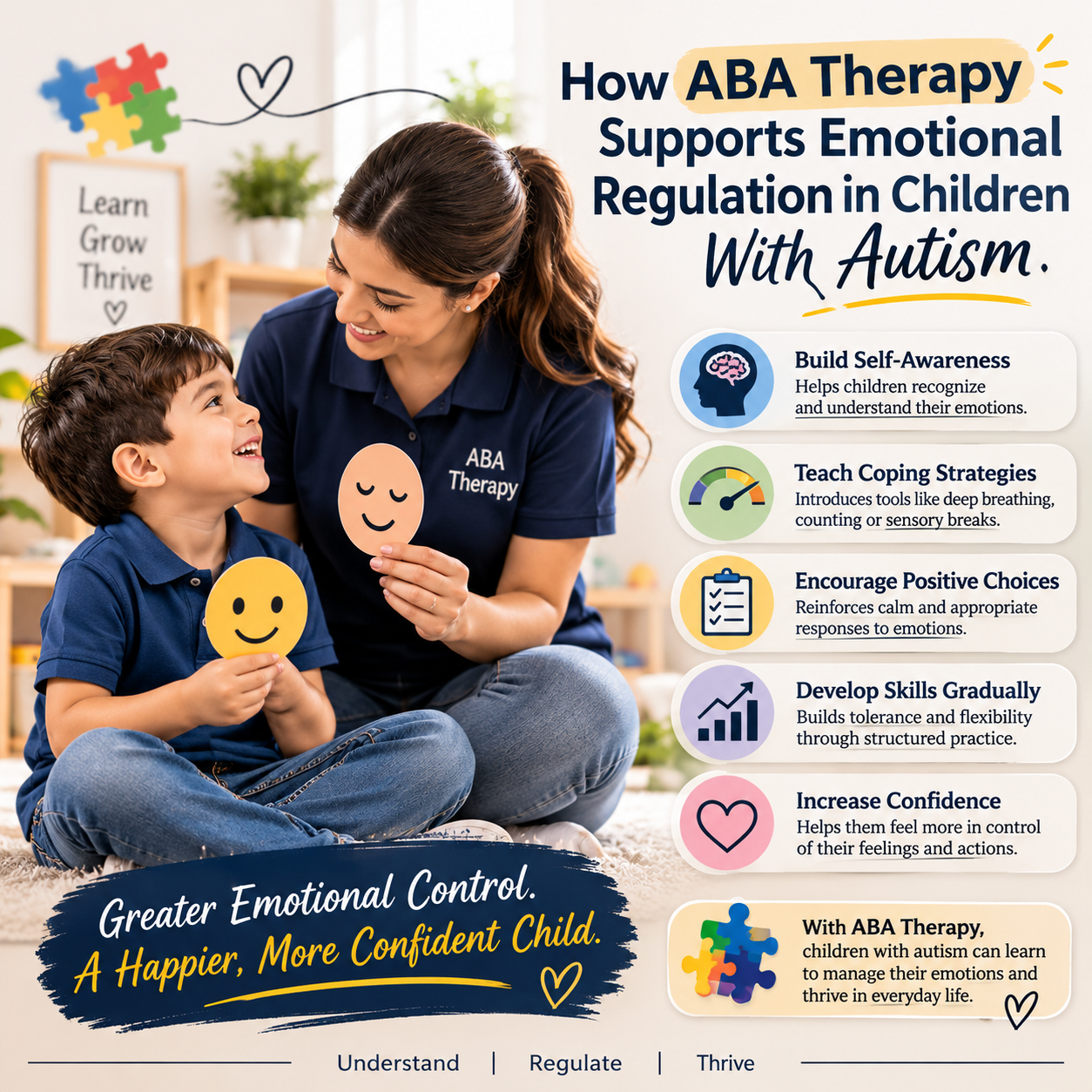
Five Emotional Regulation Strategies Parents Can Try
You can discuss the following autism emotional regulation strategies with your child’s therapist and adapt them to your family’s routine:
- Make transitions easier to understand
Leaving the park, ending a game or getting ready for bed can be difficult when a child does not know what will happen next. A visual schedule, timer, or simple advance warning may help.
Warnings will not prevent every difficult transition, but they can reduce uncertainty for some children.
- Give the child a reliable way to ask for a break
A child might use words, a gesture, a picture, or an AAC system to communicate that they need a pause. Practice the request during an ordinary activity so the child knows how to use it. Learn how to respond, including when a task can be paused and when safety needs to be considered.
- Notice early signs of discomfort
Some children become quieter when overwhelmed. Others pace, cover their ears, repeat questions, or try to leave.
These signs are not universal, and the same behavior can have different meanings. Use them as a reason to check what the child might need, rather than assume you already know.
- Reinforce useful communication
When a child asks for help, communicates discomfort, or uses an agreed coping strategy, acknowledge the effort and respond consistently.
Positive reinforcement can make an effective response more likely to be used again.
How Can Families Tell Whether ABA Support Is Helping?
Progress might mean that the child starts asking for help, communicates discomfort more clearly, or recovers with less difficulty when a familiar situation becomes stressful.
Depending on the child’s goals, the therapy team may look at whether the child uses a communication method to request assistance or a break, recognizes or communicates early signs of distress, manages particular transitions with appropriate support, and participates more comfortably in everyday activities.
These observations need to be considered alongside the child’s well-being. A reduction in visible behavior does not mean the child feels better. Some children may hide their distress when they do not feel able to communicate it safely.
Why Parent Involvement Is Important?
A child may practice a skill during therapy but find it difficult to use at home if the situation is different. A break card that works during a session will be less useful if nobody at home understands what it means or how to respond.
Parents can help by sharing information about routines, triggers, and the strategies their child prefers. Therapists can explain how to practice relevant emotional regulation skills for autism in everyday situations and how to respond when a strategy is not working.
There should also be room to adjust the plan. If a strategy repeatedly increases distress, the family should be able to raise that concern and work with the therapist to reconsider it.
About Willow Reach
Emotional regulation for autism needs differ from child to child. One family may need help with transitions and communication, while another may be investigating how to support sensory needs or reduce distress during daily routines.
At Willow Reach families can learn about in-home ABA therapy, assessments, and parent enrichment and training. The provider describes an individualized approach that considers children’s needs and works with families to support skills at home and in the community.
Parent enrichment can be especially useful when caregivers want guidance on communication, responding to difficult moments, and using agreed strategies during everyday routines.
Before starting a program, parents should feel comfortable asking how goals will be selected, how progress will be measured, and how their child’s communication, preferences, and comfort will be considered.
The right plan should give the child more ways to express themselves and access support. It should not require them to hide distress or comply with every demand regardless of how they feel.
Families interested in discussing their child’s needs can contact Willow Reach to ask about services and the assessment process.
Frequently Asked Questions
1. Can ABA therapy help with emotional regulation in autism?
Answer: ABA may help children develop communication, transition, and coping skills that support emotional regulation. The approach is usually individualized.
2. What are common emotional regulation strategies for autistic children?
Answer: Strategies may include visual schedules, functional communication, advance notice of transitions, appropriate sensory adjustments, and practicing coping skills when calm.
3. Does ABA aim to stop meltdowns?
Answer: ABA does not suppress emotional expression, but it focuses on understanding what contributes to distress and teaches useful skills.
4. How can parents support self-regulation at home?
Answer: Parents can create predictable routines where helpful, make communication tools available, notice patterns, and follow strategies agreed upon with the therapy team.