


The appointment is next week. You have filled out the paperwork, spoken with your child’s doctor, and maybe spent a few late nights reading about ABA therapy online. Even after all that, one question keeps coming back. “What actually happens during the assessment?”
For many parents, this isn’t just another appointment. It feels like the beginning of something much bigger. You want to make the right decision, but you also wonder how your child will react in a new place with someone they have never met before. An ABA assessment is designed to answer those questions. It isn’t an exam, and your child isn’t expected to perform in a certain way. Instead, it helps us understand how your child learns, communicates, and experiences everyday life.
That information helps guide the ABA evaluation process, making sure therapy begins with realistic goals that fit your child’s needs rather than someone else’s.
If this is your family’s first ABA assessment, here’s what you can expect from the moment you arrive.
The Assessment Starts Before the Appointment
Parents are sometimes surprised to learn that the assessment begins before the appointment itself.
You will receive forms asking about your child’s medical history, development, previous therapies, school experiences, and daily routines. This is part of the ABA intake process, and while it may feel like a lot of paperwork, every answer helps build a clearer picture of your child.
Don’t worry if you can’t remember the exact age they started speaking or the month they learned a new skill.
The goal isn’t to test your memory. It’s to understand your child’s journey so far.
What To Expect During ABA Assessment?
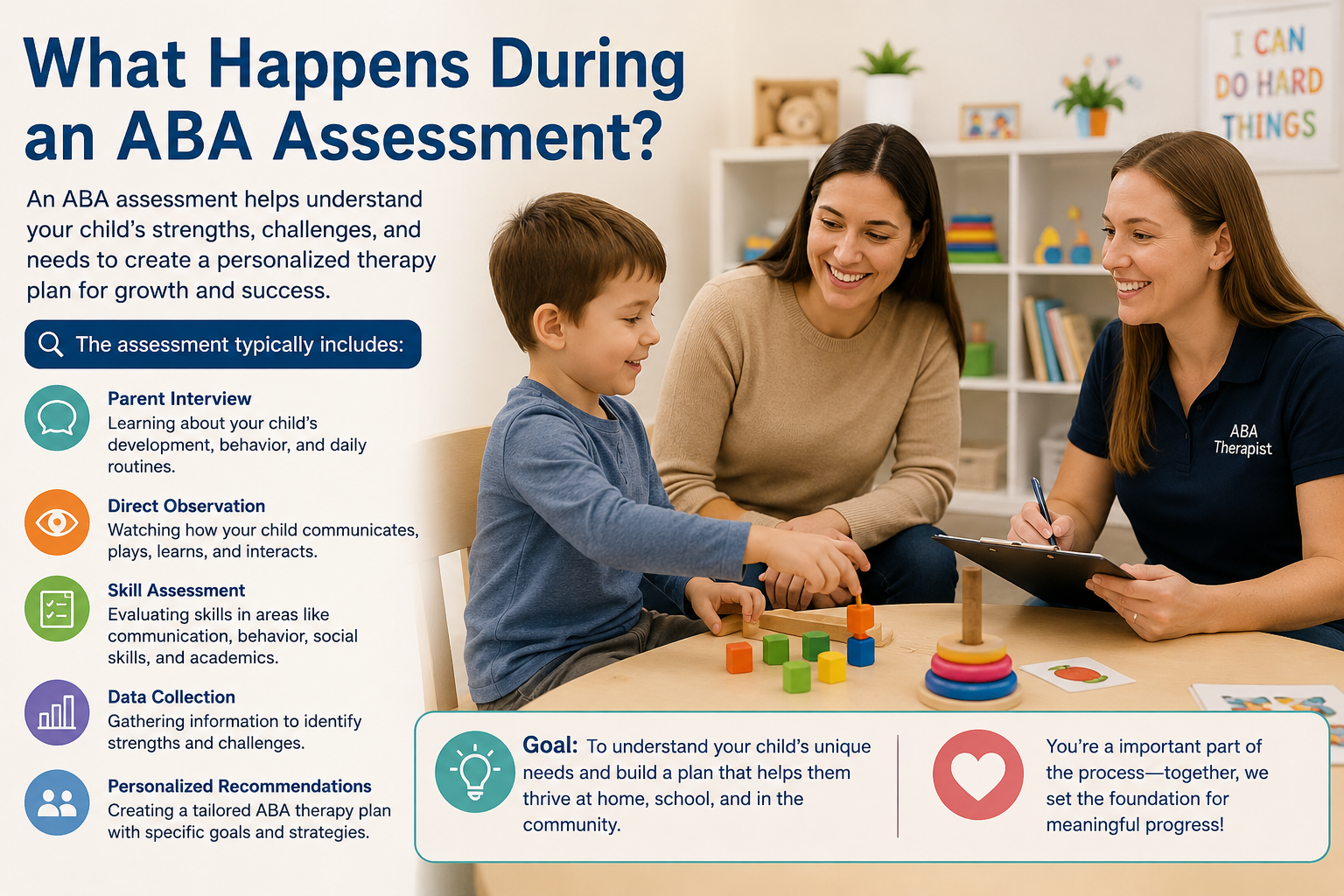
One mother once laughed and said, “I thought my son was coming for the assessment. I didn’t realize I was too.” She wasn’t wrong. Parents are a part of the process because you see things no therapist can observe during a single visit.
During the first ABA assessment, you will talk about everyday life, what mornings look like, how bedtime usually goes, or if your child enjoys being around other children or prefers to play alone.
Maybe you will mention that brushing teeth has become a daily battle. Or that your child happily talks at home but goes completely quiet in unfamiliar places.
Those details are often far more helpful than simply hearing a list of diagnoses.
Your Child Isn’t Expected to Sit Still for Hours
This is one of the biggest fears parents have going into an autism assessment for ABA. Many imagine a child sitting across from an adult answering questions one after another. Most assessments don’t look like that at all. Often, the therapist starts by getting on the floor.
They might roll a ball back and forth, blow bubbles, build a tower, or read a picture book. At first, it can feel ordinary. You may even find yourself wondering, “When does the assessment actually start?”
The truth is, it already has.
Play Is the Assessment
Children often reveal far more about themselves through play than conversation. Imagine a favorite toy sitting just out of reach. Some children point, some ask for help, while others take a parent’s hand and gently guide them toward the toy. A few quietly look for another solution without asking anyone.
Every one of those responses tells a story about communication. It answers how a child solve problems, how they let people know they need something, or how comfortable are they trying something new.
Those answers shape the rest of the assessment far more than memorizing letters, colors, or numbers ever could.
What Information Therapist Tries to Find Out
| Area | What Therapist Tries to Find Out |
| How your child shares needs, wants, and ideas | |
|
Social Interaction |
How they respond to people and shared activities |
| Daily Living Skills | Independence with everyday routines |
| Learning | Attention, imitation, and problem-solving |
| Play | Interests, imagination, and flexibility |
Sometimes the Most Difficult Behaviors Make the Most Sense
There is one moment during the assessment that many parents worry about. “What if my child has a meltdown?” If that happens, take another deep breath. An experienced therapist isn’t shocked by tears, frustration, or refusing to join an activity. In fact, those moments can be some of the most valuable parts of the ABA assessment.
Imagine your child is happily building with blocks. A few minutes later, the therapist asks them to put the blocks away and move to a different activity. Your child becomes upset. To someone watching from across the room, it may seem like they simply don’t want to listen. The therapist sees something different.
Was the transition unexpected? Did your child understand what was being asked?
Were they enjoying the activity so much that stopping felt overwhelming?
Those questions matter because therapy isn’t about stopping behavior. It’s about understanding what caused it.
What Is Functional Behavior Assessment?
You may hear the therapist mention a functional behavior assessment, often shortened to FBA. Every behavior has a reason; sometimes children are asking for attention, or they are trying to avoid something difficult. Sometimes they are communicating frustration because they don’t yet have another way to express it.A functional behavior assessment helps identify those patterns.
What Therapist Notices And How It Helps
What happened just before the behavior may reveal a trigger. What did the child actually do? What happened afterwards? It shows whether the behavior helped the child get or avoid something.
The goal here is to replace frustration with communication.
Parents sometimes apologize before the appointment even begins. May be the child didnt sleep well the last night, or they are having one of those days. Such comments from parents are quite common.
“The good news is your child doesn’t have to impress anyone. The assessment isn’t about catching children on their best day. It’s about understanding who they are on an ordinary one.
If your child needs extra time to feel comfortable, that’s okay. Every child approaches new situations differently, and an experienced clinician expects exactly that.
Walking Out With Answers Instead of More Questions
By the end of the appointment, most parents feel surprisingly relieved because they finally have a clearer direction. The therapist reviews everything gathered during the ABA evaluation process.
That includes:
- Your family’s concerns.
- Your child’s communication skills.
- Play and learning observations.
- Daily living abilities.
- Results from the Functional Behavior Assessment, when appropriate.
All of that information becomes the foundation of an individualized treatment plan. Some children need help asking for what they want while others need support with social interaction.
Some are ready to learn daily living skills that build independence at home. There isn’t one “correct” therapy plan because there isn’t one type of child.
A Few Things Worth Bringing
Parents should carry previous therapy reports, school evaluations, a favorite toy or comfort item, snacks or drinks if your child may become hungry, and a list of questions you have been meaning to ask.
Just let them be themselves; that’s who the therapist wants to meet.
Looking for ABA therapy in Maryland?
Families searching for ABA therapy in Maryland often compare providers based on location, schedules, or insurance coverage. But here’s another question worth asking.
How much time does the provider spend getting to know my child before recommending therapy? A thoughtful assessment should never feel rushed; it should feel like a conversation.
At Willow Reach ABA, the assessment is designed to understand the child and not just a diagnosis. That means listening to parents, observing naturally, identifying strengths, and creating goals that make sense for everyday life.
Therapy works best when it starts with understanding.
Final Thoughts
An ABA assessment isn’t about finding everything your child can’t do. It’s about discovering how they learn, how they communicate, what motivates them, and where they need support. The more clearly those pieces come together, the easier it becomes to create therapy that’s meaningful for your child and realistic for your family.
If you are getting ready for your child’s first ABA assessment, remember this one thing.
Your child isn’t expected to be perfect; they just need to be themselves.
Frequently Asked Questions
- How long does an ABA assessment usually take?
Answer: Most appointments last between two and three hours. Afterward, the therapist reviews the findings, prepares a treatment plan, and completes any insurance documentation if needed.
- What should I expect during an ABA assessment?
Answer: Expect a relaxed environment rather than a formal test. The visit usually includes conversations with parents, play-based observations, developmental skill evaluations, and, when appropriate, a functional behavior assessment.
- Will my child have to answer many questions?
Answer: Many children communicate through play, gestures, or simple interactions. The assessment is adapted to your child’s age and communication style.
- Can parents stay during the assessment?
Answer: Yes, parents are encouraged to be involved because they offer invaluable insight into their child’s daily routines, strengths, and challenges.
- Does every child receive the same therapy plan?
Answer: No, every treatment plan is created after the autism assessment for ABA and is based on the child’s unique strengths, developmental needs, and family goals.