

Parents often hear that children learn best when they get opportunities to practice new skills outside therapy. But what does that actually look like at home? For a family already managing school, work, meals, and bedtime, adding more activities can feel like another responsibility.
The good news is that practicing ABA therapy at home does not always need a separate time slot. A child can work on asking for help while opening a snack packet, learn to put away toys after playing, or become more comfortable with a morning routine by following the same steps each day. These are ordinary moments, but they can be useful when a child is learning a new skill.
The trick is knowing when to help, when to wait, and when to leave the activity alone.
What Does ABA Therapy at Home Involve?
Applied Behavior Analysis (ABA) is an approach used to understand learning and support skills that matter in everyday life. For autistic children, these may include communication, self-care, play, following routines, and participating in family activities.
With in-home ABA therapy, a trained professional works with the child in their home. The therapist may practice specific skills, observe what makes tasks difficult, and help the family understand how to support progress between sessions.
The parent’s role is to use the strategies agreed upon with the therapist when a suitable opportunity comes up.
Consider a child who can ask for a toy during a session but does not make the same request at home. The child may need more opportunities to use that skill with family members and in different situations.
This process is called generalization, and it is an important part of making learning useful beyond the therapy room.
Start With the Routine That Causes the Most Trouble
There is little benefit in trying to work on every skill at once during autism learning at home. If getting ready for school is a daily struggle, focus on that first. If your child finds it hard to ask for things, look for opportunities to support communication during meals or play.
A small, specific goal is easier to work on than a long list of expectations. It also makes it easier to notice whether the approach is helping.
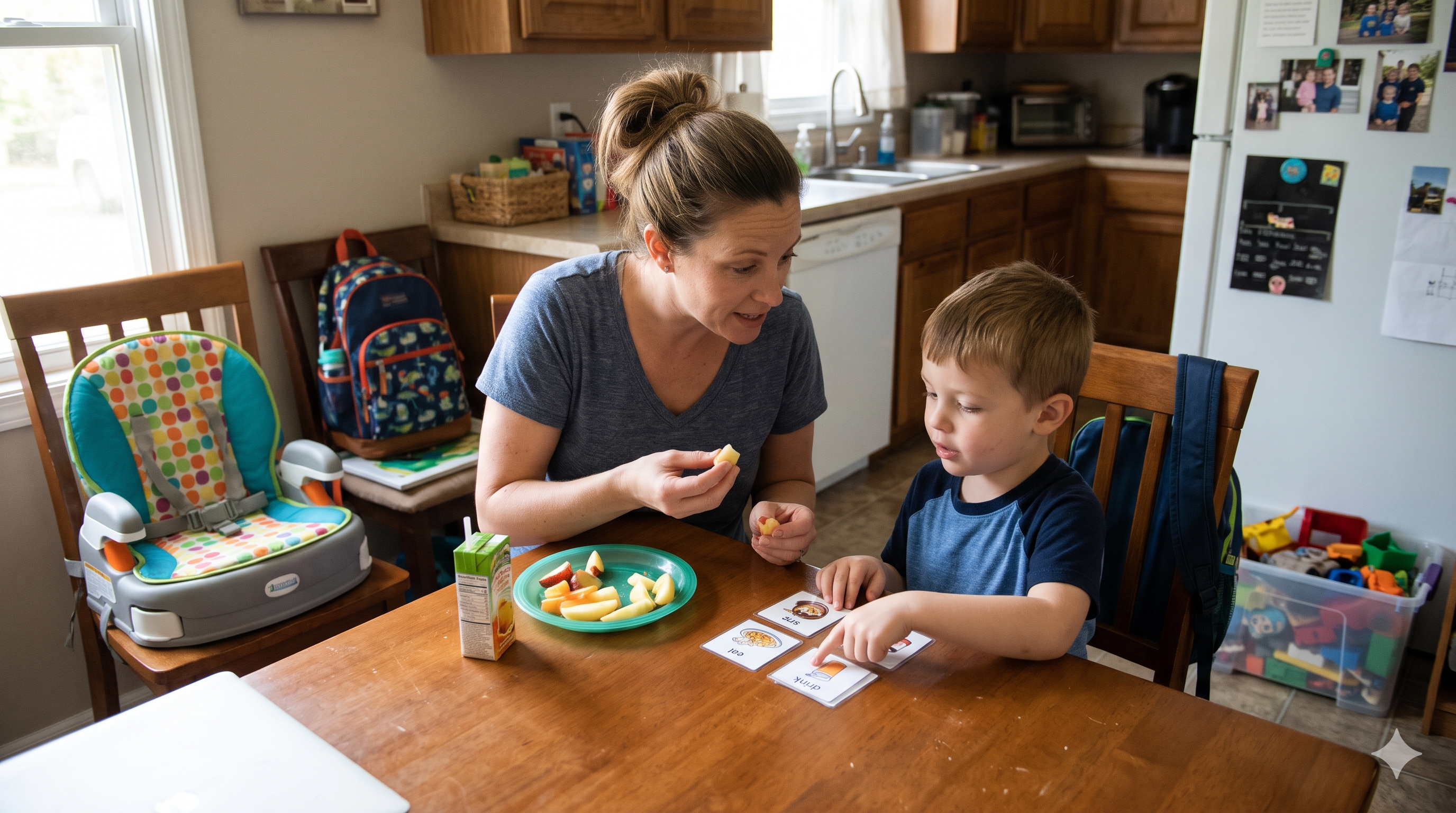
Mealtimes Are an Opportunity to Practice Communication
Your child wants water but usually waits for you to bring it. Rather than guessing immediately, you can give them a moment to communicate what they need. That communication might be a word, a gesture, a picture, or a button on an AAC device.
If your child is already able to request items, you might practice this skill in a different situation. A child who asks for a favorite toy could also learn to ask for a spoon or help opening a container. The aim is to make communication useful in daily life.
Choices can help, too. Asking, “Would you like an apple or a banana?” gives your child a clear opportunity to express a preference, provided both options are available.
There is no need to turn lunch into a lesson in table manners or following instructions as a part of home-based ABA therapy. A child might be ready to carry a plate to the table but not yet able to manage several tasks independently. Let them participate at a level that makes sense for them.
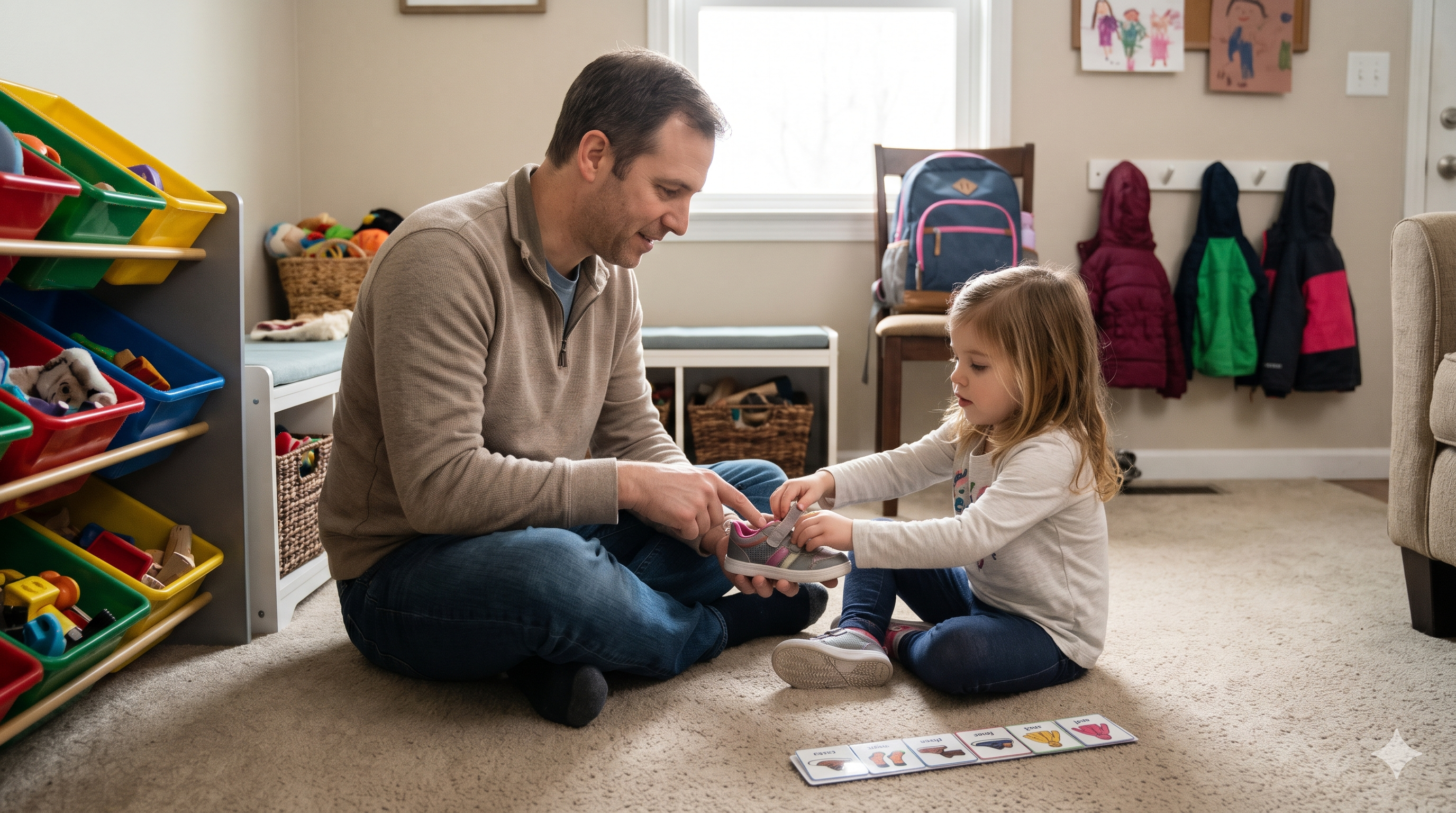
Getting Dressed
Mornings can be rushed, so it is often easier for a parent to put on a child’s shoes or finish dressing them than to wait while the child tries. But when time allows, leaving one manageable step for the child can create an opportunity to practice independence.
Suppose your child can pull up their trousers but needs help with the rest of dressing. You could focus on that one part rather than expecting them to complete the whole routine.
ABA professionals may use task analysis to break an activity into smaller steps. For getting dressed, those steps might include choosing clothes, finding the correct opening, putting on a shirt, and pulling it into place. The child receives help with the parts they have not yet mastered.
Another method, called backward chaining, involves helping with the earlier steps while the child completes the final one. As that final step becomes familiar, the child can gradually take on more of the task. A therapist can show you how to use this approach for your child’s particular needs.
Some children also benefit from a simple picture sequence showing what comes next. Others manage better with a brief reminder. There is no need to introduce a visual schedule if your child does not find it helpful.
Let Play Begin With Your Child’s Interests
Parents sometimes worry that playing with a child is not productive unless they are teaching something. In reality, following a child’s interests can be a helpful starting point for interaction.
If your child likes building towers, sit nearby and add a block when they seem comfortable with you joining in. These small exchanges may provide opportunities to practice waiting, sharing attention, or communicating choices.
Do not worry if your child prefers playing alone for part of the time. Nor does every game need to involve eye contact or follow a particular pattern. The purpose is to support useful skills while respecting the way your child enjoys playing.
When Moving From One Activity to Another Becomes Difficult
Some children find transitions harder than the activities themselves. They may be content playing with blocks but become upset when asked to stop and get ready for bed. This does not mean they are being uncooperative.
A sudden change can be difficult to understand, especially when the next activity is less appealing. A short warning, a visual timer, or a clear explanation of what comes next may help.
For example, you could say, “We’ll put the blocks away in five minutes, then choose a book.” When the time comes, use the same simple cue rather than giving several instructions at once.
A first-then approach can be useful here: first complete a manageable step, then move to a preferred activity. It should not become a threat, and it will not solve every transition problem. If your child regularly becomes distressed, look at whether the change is too abrupt, the task is too difficult or the environment is uncomfortable.
Bedtime Does Not Need to Become a Battle
By the end of the day, children are tired and parents are often tired, too. A bedtime ABA home routine that involves too many reminders can leave everyone frustrated.
Try looking at the sequence rather than focusing only on the behavior. Is your child expected to change clothes, brush their teeth, tidy toys, and get into bed in quick succession? Would a simple checklist make the order clearer? Could one step be made easier?
If brushing teeth is difficult, break it down. Your child might begin by getting the toothbrush ready, then practice brushing for a manageable amount of time. Give help where needed and allow them to attempt the steps they can do.
Sensory discomfort can also make bedtime tasks unpleasant. Toothpaste taste, bathroom noise, clothing textures, or fatigue may be contributing factors. If the routine regularly ends in distress, discuss these possibilities with your child’s therapist instead of repeating the same instruction more firmly.
The purpose of a routine is to make the evening easier to manage. It does not have to be followed perfectly every night.
How Willow Reach Can Help Parents
At Willow Reach, families can work with professionals to identify practical goals and understand how to support children outside sessions. Parents can ask which skills to focus on, how much help to provide, and what to do if ABA strategies at home fail.
This guidance is important because a technique that helps one child may not suit another. The aim is to find an approach that fits the child’s abilities and the family’s circumstances, rather than adding a long list of ABA activities at home to an already busy day.
Frequently Asked Questions
1. Can parents use ABA strategies at home without being therapists?
Answer: Parents can support skills such as communication, dressing, and participation in routines. For specific behavior interventions, they must follow guidance from an ABA professional.
2. How much time should we spend on ABA activities at home?
Answer: ABA activities at home do not require a fixed number of hours. Most opportunities to teach something new arise naturally while taking meals, playing, or doing self-care.
3. What if my child refuses to do an activity?
Answer: If something like this occurs, pause and consider what might be making it difficult. Your child may need more time, clearer instructions, or help with a particular step. Sensory discomfort, fatigue, and difficulty communicating can also play a part.
4. Does ABA therapy at home mean following a strict routine?
Answer: No, routines should be flexible because parents want to help children develop skills they can use in real situations, including when plans change.