

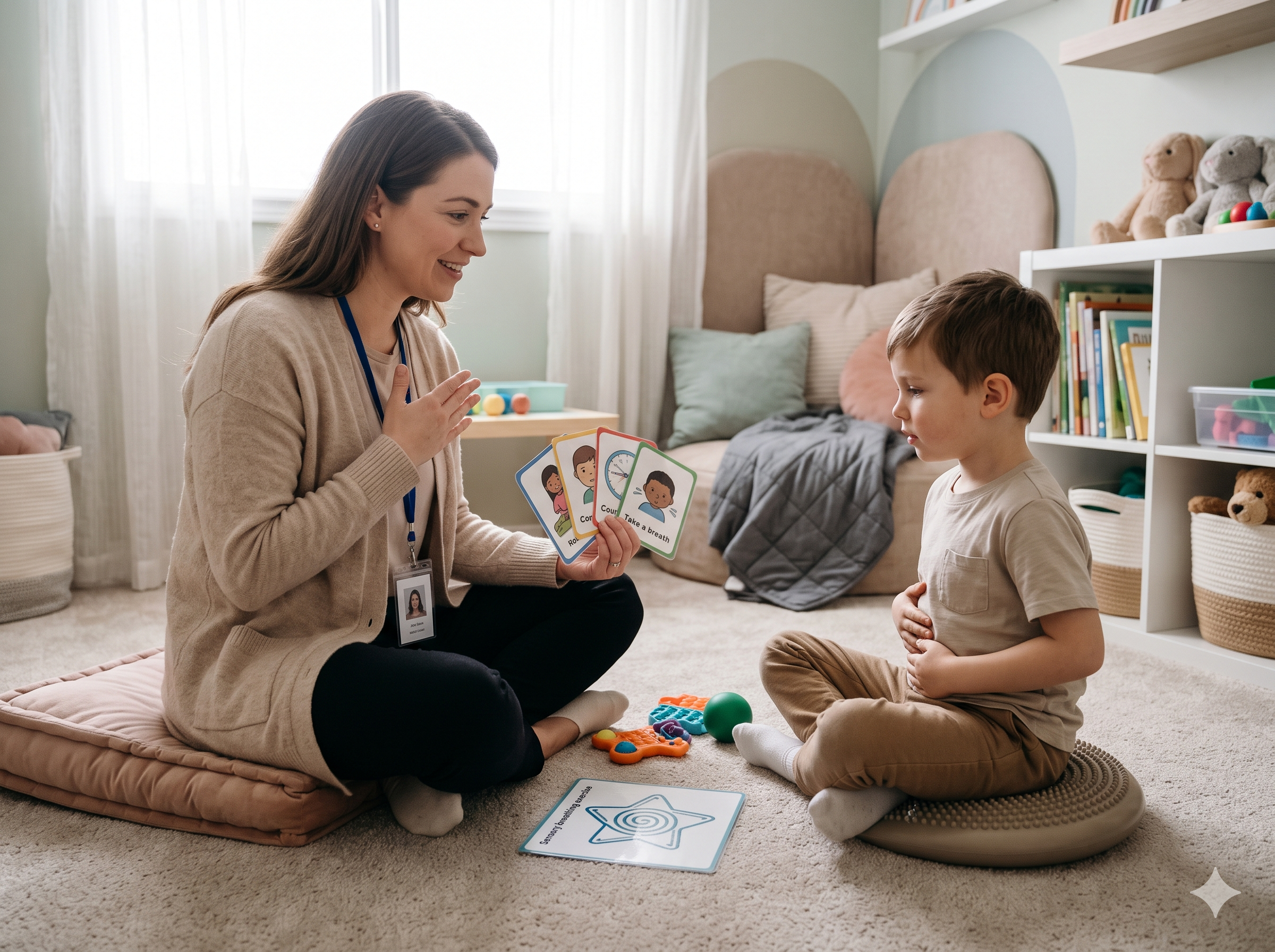
Parents of autistic children often know when something is wrong before their child can explain it. Maybe your child suddenly refuses to go to school, or a change in the usual routine leads to a big reaction. Sometimes, anxiety in autistic children shows up as crying or a meltdown, but it can also make them quieter.
A child may withdraw, repeat the same question over and over, stim more than usual, or avoid a place or activity they previously enjoyed.
For a child with autism, many things can cause anxiety. Sensory sensitivities, social situations, routine changes, and communication issues can all play a part.
ABA therapy can help identify what is making a situation difficult and teach the child how to respond. That might mean asking for a break, communicating that something is too loud, following a visual schedule, or gradually becoming more comfortable with a situation that once felt overwhelming.
Why Anxiety Can Be Difficult for an Autistic Child?
Anxiety is not a defining characteristic of autism, but autistic children may experience anxiety in ways that are different
A crowded shopping center can mean bright lights, conversations happening all around, music, announcements, movement, and unfamiliar smells. A child who is sensitive to sensory input may become overwhelmed in such a situation.
Some children cope much better when they know what is going to happen next. A last-minute change in plans, a substitute teacher at school, or an unexpected trip can therefore be genuinely difficult.
Communication can make the situation harder. A child may know that something is wrong but not have the words to explain it.
They may not be able to say:
- The room is too loud
- I don’t understand what you want me to do
- I need a few minutes before we continue
The distress may come out through crying, refusal, aggression, withdrawal, repetitive behavior, or other challenging behaviors . Understanding this difference is important. The behavior is something we can see. The reason behind it may not be immediately visible.
Looking for the Reason Behind the Behavior
One of the first things an ABA professional may do is search for patterns. A functional behavior assessment can help identify what happens before a behavior, what the behavior looks like, and what happens afterward. The ABC framework is often useful:
- Antecedent: What happened immediately before?
- Behavior: What did the child do?
- Consequence: What happened immediately afterward?
For example, imagine a child who covers their ears and runs from the classroom every time the school bell rings. It would be easy to focus on the running and say, “We need to stop this.”
But there are other questions to ask.
Is the sound itself painful or overwhelming? Does the child know what the bell means? Is there another difficult activity immediately afterward? Does leaving the classroom provide relief?
The answers are important because the intervention should be based on what the child actually needs.
FBA is a great way of identifying autism and anxiety in children and using those observations to develop a more personalized approach.
Teaching a Child to Communicate When Something Is Wrong
For some children, one of the most useful anxiety-management skills is simply learning how to ask for help and develop communication skills. Functional Communication Training (FCT) can teach a child to communicate a need.
A child may learn to say:
- I need a break
- Too loud
- Help me
- I am scared
- I don’t want to do this
Not every child will use spoken language. Some may use gestures, pictures, an AAC device, or another communication system. The method is less important than the outcome because the child has a reliable way to tell someone what they need.
Coping Skills Are Taught When the Child Is Calm
One common mistake is waiting until a child is already overwhelmed before trying to teach coping strategies.
At that point, learning something new can be very difficult. Emotional coping skills for autism are usually more useful when they are introduced and practiced during calmer moments.
An ABA therapist might teach a child using modeling, prompting, repetition, and reinforcement while the child practices.
A visual schedule can show what is happening during the day.
Social stories can also prepare a child for something unfamiliar, such as a dentist appointment, a birthday party, a new classroom, or a family trip.
Making Transitions Less Stressful
For many families, transitions are where the day becomes difficult. Visual information may help in making transitions less stressful. It gives the child something concrete to follow.
Instead of repeatedly saying, “We are leaving soon,” a visual sequence might show:
Play → Clean up → Shoes → Car
The child can see what comes next.
This does not mean every transition will suddenly become easy. Some children will still protest. Some days will be more difficult than others.
But predictability can remove some of the uncertainty from the situation.
Helping Children Gradually Face Difficult Situations
If a child is terrified of the dentist, it may be better to avoid the dentist. When a grocery store triggers a meltdown, it may feel much easier to shop without the child.
Sometimes avoidance is necessary, particularly when an environment genuinely presents a sensory or safety concern. But when avoidance becomes the only way a child copes with a manageable fear, it can also limit the child’s experiences.
This scenario is where gradual exposure or systematic desensitization may be considered.
The therapist may teach autism coping skills and use reinforcement when the child makes progress.
The therapist may teach coping skills alongside experiences and use reinforcement when the child makes progress. The idea is to build familiarity and tolerance without overwhelming the child.
Reinforcing the Coping Skill
Positive reinforcement is an important part of ABA.
The therapist may acknowledge a child with praise, a preferred activity, tokens, or another form of reinforcement that is meaningful to them. The idea is to promote children to make a positive change and make it worth repeating.
It can help strengthen a skill that gives the child a better way to communicate or cope.
Parents Are Part of the Process
An ABA session is only one part of a child’s day. A child may learn to request a break during therapy, but what happens when they become overwhelmed at home? At school? In a restaurant? During a family trip?
This is why parent involvement is important. Parents can learn what signs to watch for and how to prompt coping strategies for autism, how to respond when the child communicates appropriately, and how to give the child opportunities to practice outside therapy.
There will be days when the visual schedule is forgotten. There will be times when the child becomes overwhelmed despite everyone’s best efforts.
What matters is that the child continues to get opportunities to use the skills in different situations.
What Does Progress Look Like?
Parents usually think anxiety management means fewer meltdowns. That can certainly be part of progress, but it is not the only measure. Progress might look like a child who used to run away now asking for a break.
It might be a child who still becomes nervous at the dentist but can remain in the waiting room. It could be a child who becomes upset when plans change but can look at a visual schedule and accept the next activity with some support.
These changes may seem small to someone looking from the outside, but they are not small to the child.
Over time, these skills can lead to independence and participation in everyday activities.
How Willow Reach Can Support Your Child
At Willow Reach, ABA therapy for anxiety can be individualized around the child rather than treating anxiety as one problem with one solution.
The process begins with understanding what is happening. What situations are difficult? What happens just before the distress? How does the child communicate? Are sensory issues involved? Are transitions particularly difficult?
Once the therapy team better understands these patterns, it can work with the family on practical goals.
These may include functional communication, emotional awareness, coping strategies for autism, transition skills, social skills, or gradually becoming more comfortable with situations that currently cause distress.
Final Thoughts
Anxiety can make ordinary childhood experiences much harder for an autistic child.
ABA therapy for anxiety can help by looking at what is behind the child’s distress and teaching practical alternatives.
It will not remove every uncomfortable feeling, but help a child become better equipped to handle tough feelings.
Frequently Asked Questions
1. Can ABA therapy help with anxiety in autistic children?
Answer: ABA can help children develop practical skills for handling anxiety. The therapy focuses on identifying triggers, improving communication, supporting transitions, and increasing tolerance levels.
2. How can parents help an autistic child who is anxious?
Answer: Parents must start with identifying patterns. Pay attention to what makes them anxious and what soothes them. If anxiety is interfering with everyday life, it’s time for ABA therapy.
3. Does ABA therapy cure anxiety?
Answer: ABA helps a child develop practical ways to communicate, cope with difficult situations, manage responses, and participate more independently in everyday activities.
4. How to reduce anxiety in an autistic child?
Answer: To reduce anxiety in an autistic child, it is important to identify the triggers that cause it. It can be done by identifying what the triggers are, using predictable routines, and offering sensory and visual supports.
5. What are coping skills in ABA therapy?
Answer: ABA teaches coping skills to children by breaking down emotional regulation and stress into well-structured and reinforced steps. These coping skills are communication-based skills, calming techniques, emotional recognition, and problem-solving frameworks.